Water quality Testing on the Afon Cegin
As part of our Roots project our project staff have been doing monthly water quality monitoring of the Afon Cegin. These surveys aim to identify general trends in water quality across the catchment and assess the impact of permitted discharges. Permitted discharges allow companies or properties to release waste to the river within limits specified in the permit. There are 17 permitted discharges on the Afon Cegin, covering treated sewage, CSOs, road run-off, and industrial waste.
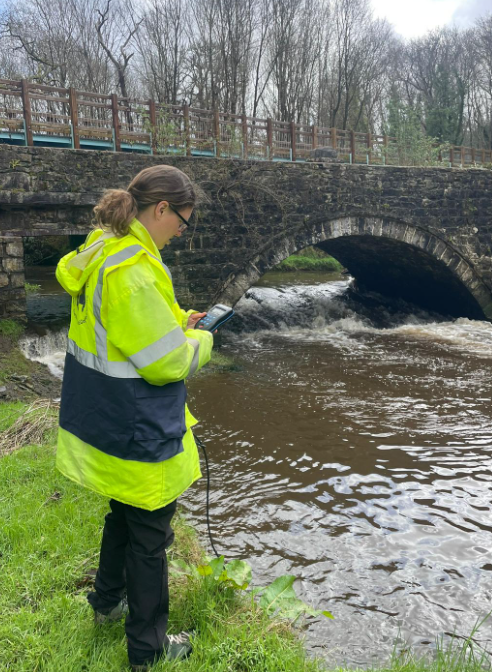
What did we measure?
The survey measured a range of water quality parameters, but the focus of our analysis was on Nitrates (NO3) and Oxidation Reduction Potential (ORP).
Why those qualities?
It is estimated that in Wales over 60% of nitrate inputs into freshwater come from agriculture with the next highest input at 17% coming from sewage effluent (Watts, 2023). Agricultural run off can include manure, fertiliser and sewage sludge whilst the input from sewage effluent includes discharges and leaks (Watts, 2023).
Nitrate levels exceeding 10 mg/L can be harmful to some aquatic organisms. High nitrate concentrations along with phosphates will also lead to eutrophication. Eutrophication is a decline in oxygen levels brought about by excessive algal growth.
ORP measures the ability of a river to cleanse itself or break down waste products, such as contaminants and organic matter. Within freshwater rivers a healthy ORP range is 300-500mV (DataStream, 2021).
What did we find?
There is a cluster of low ORP values within the Llandegai Industrial Estate. These low ORP values can be contrasted with the much higher value recorded approximately 1km upstream. Nitrate concentrations at the same locations were also much higher than 1km upstream. The lower oxidation potential coupled with the high Nitrate concentrations are indicative of increased pollution inputs and a lowering of the river's ability to remove them.
A Dŵr Cymru Waste Water Treatment Works (WWTW) is located in Rhiwlas. Three sample points showed that Nitrates were higher upstream of the discharge. This could indicate additional sources of pollution into the river, potentially from agricultural runoff.
Community support
These monthly tests are also being supported by our Lab Dwr citizen scientists who are taking additional readings throughout the month.