
Electrofishing the Clywedog
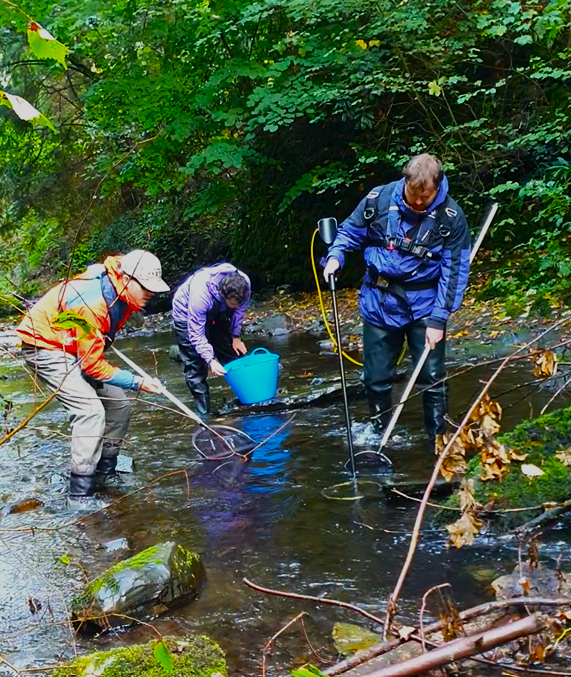
This week, members of our team headed out to the Clywedog to carry out an electrofishing survey, helping us build a clearer picture of the river’s fish population and its current ecological health.
The survey will provide valuable information to support ongoing river restoration and management plans, helping us understand which fish species are present, their abundance and how the population is changing over time.
So, what exactly is electrofishing?
The name might sound a little sinister, or even futuristic but electrofishing is actually a well-established and carefully controlled method of surveying fish populations. When carried out correctly by trained surveyors, it allows fish to be temporarily stunned and safely captured for identification and measurement before being returned to the river.
The equipment may look a little unusual. A surveyor wears a backpack containing a battery, connected to a negatively charged cathode that sits in the water. They also carry a handheld pole, or anode, which has a positive charge and a trigger to control the electrical current.
When the current is applied, it creates an electrical field in the water. Fish within this field are temporarily immobilised, allowing the survey team to carefully capture them using nets. Each fish can then be identified, measured and recorded before being returned safely to the river.
By repeating surveys at different locations and over time, we can build up a much better understanding of fish communities and how they respond to changes in their river environment.
For us, surveys like this are about more than simply counting fish. Good restoration starts with good evidence, and understanding what is living in the Clywedog and how that changes over time helps us target conservation work where it can have the greatest ecological benefit.
The team at the Clywedog started out just below the weir at Bontuchel then made their way slowly upstream, spending 5 minutes at each site, capturing fish in nets and placing them in buckets of water. Each fish then had to be identified and then measured before being carefully released back into the river.
The survey measured more than 150 brown trout (Salmo trutta) parr, varying in size from 6cm to 20cm, demonstrating that the Clywedog has been a successful breeding ground for them in the last few years. 2 eels (Anguilla anguilla) were also seen by the team, but they recovered and slipped away before the nets could get to them!
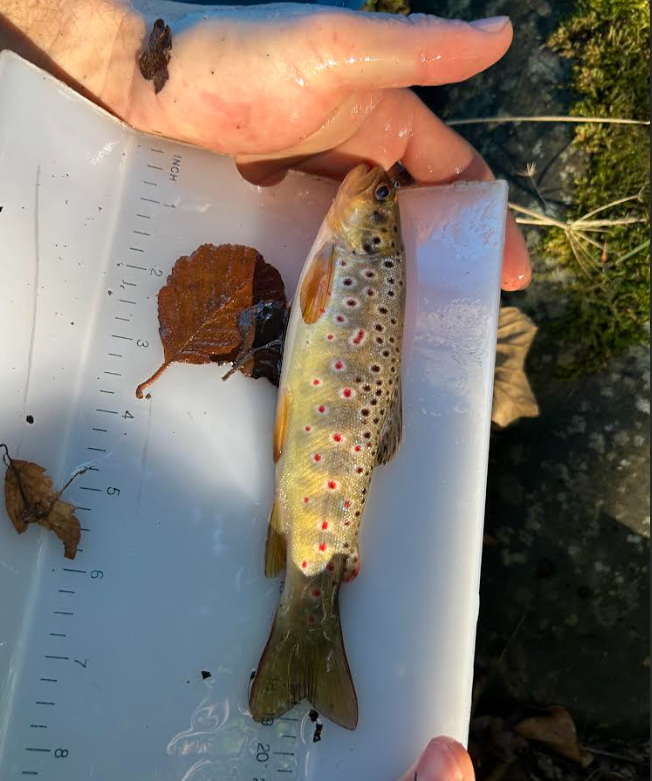
While conducting the survey, safety of the wildlife was of utmost importance and therefore careful measures were taken to ensure no fish were harmed in the process. Electrofishing itself is a non-lethal option for capturing fish, but even so the strength of the electric current that is used had to be adjusted based on the site. To ensure the voltage was not too strong, a water electrical conductivity (EC) reading was taken at each site. At sites with higher EC a lower voltage was used compared with sites with lower EC, this ensured that species in the river were not subjected to shocks capable of long-term harm or death. Additionally, only staff members that had received electrofishing training were permitted to use the equipment, ensuring that the procedure was performed safely and ethically.
This survey provided important insights into the condition of the Clywedog. The data gathered by this operation, along with other information, will be used to inform North Wales Rivers Trust’s projects in the catchment going forward.
