TRIALLING BIOCHAR DAMS ON THE AFON CEGIN
The Afon Cegin is a small, unassuming lowland river in Gwynedd that flows into the Menai Strait at Porth Penrhyn. Despite its modest size, the river is part of a wider catchment system that connects the surrounding landscape to the health of the Strait.
This pilot trial is part of Mynydd i’r Menai, North Wales Rivers Trust’s bioregion project, which brings together the river catchments that drain into the Menai Strait. The project explores how land management and river health influence the wider marine environment, while trialling practical, locally led solutions to improve water quality across the bioregion.
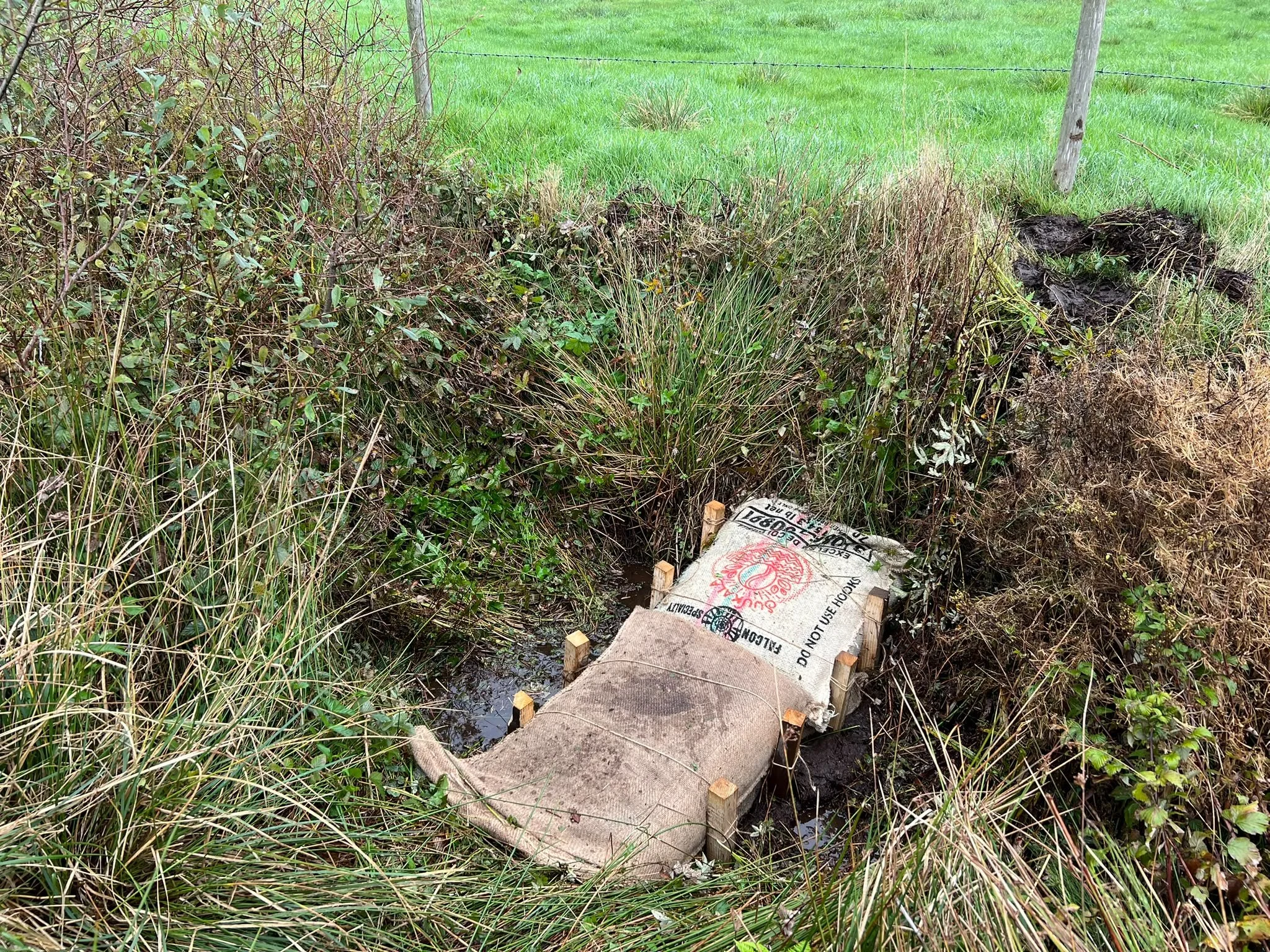
Tackling nutrient pollution in the Cegin catchment
The latest Water Framework Directive classification from Natural Resources Wales (NRW) identified temperature and excess nutrient inputs as key pressures affecting water quality in the Afon Cegin catchment.
One important source of excess nutrients is agricultural runoff. During periods of heavy rainfall, manure and fertilisers can be washed from farmland into nearby streams, drainage ditches and rivers. This increases nutrient concentrations, including nitrates and phosphates, which can contribute to poor water quality and disrupt aquatic ecosystems.
To explore a practical, nature-based approach to tackling this issue, project officers at North Wales Rivers Trust designed a pilot scheme using biochar-filled leaky dams.
A simple solution using local and recycled materials
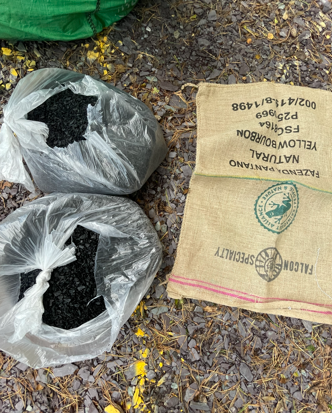
The dams are made from recycled hessian coffee sacks, generously donated by Poblado Coffi, and filled with locally sourced biochar.
Biochar is a charcoal-like material produced through pyrolysis, a process in which organic material is heated to high temperatures in the absence of oxygen. Its porous structure can make it effective at adsorbing certain substances, including nutrients and some contaminants, from water.
The filled sacks are stacked to create small, permeable barriers known as leaky dams. Rather than blocking the flow of water, these structures allow water to pass through while the biochar acts as a passive filter, with the potential to capture nutrients and heavy metals as they move through the system.
By combining recycled materials with locally sourced biochar, the trial aims to test a simple, low-impact intervention that could help reduce pollutant movement from farmland into the wider river network.
Putting the trial to the test
Working in partnership with a local cattle farmer, we installed four biochar leaky dams across a small tributary and several drainage ditches on the farm. Over the next six months, we will monitor water quality around each installation to assess how the dams perform under real-world conditions. At the end of the trial, the dams will be removed and the biochar sent for analysis to investigate which substances it has captured.
The findings will help us understand the potential of biochar leaky dams as a practical tool for reducing nutrient pollution in agricultural catchments. This pilot is an opportunity to test an innovative approach at a local scale and build evidence to inform future work across the Mynydd i’r Menai bioregion.
By working collaboratively with farmers and making use of locally available and recycled materials, we hope to identify practical ways to improve river health and protect the wider ecosystem of the Menai Strait bioregion.