Record lows of rainfall across the UK
This summer has seen record lows of rainfall across the UK, Wales being no exception. In July Wales recorded just 9.3mm of rainfall, or 9% of the month’s long-term average, breaking the previous record of 22.6mm (1911) by a significant margin. August was slightly wetter, mainly due to rains that came at the end of the month to break the drought, with as much as 38.8mm of rain recorded in a day at one raingauge in North Wales. Unsurprisingly, this prolonged dry period has put significant pressure on our rivers, leading to concerns over how this is managed in an increasingly changing climate.
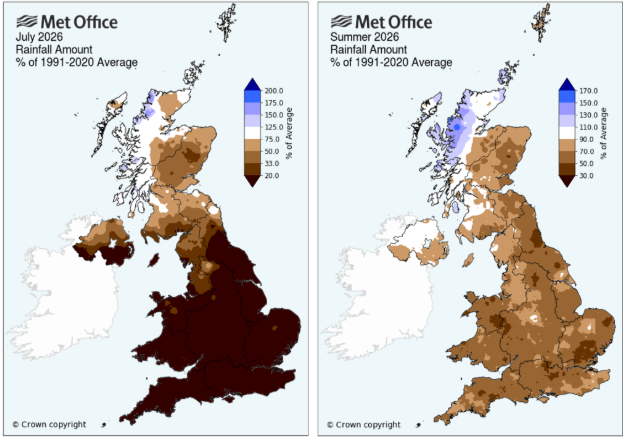
Met Office rainfall maps for July and August 2026 as a percentage of the average for the same months between 1991 and 2020.
Analysis of Welsh river level data by Afonydd Cymru showed an alarming picture of water heights during the latest heatwave, with many of Cyfoeth Naturiol Cymru’s (CNC) gauging stations registering lowest recorded levels.
As of the 17th of August 2026, 4 gauging stations across North Wales were registering lowest recorded levels (since the station was built), with a further 12 within 3cm of this mark.
Many of the stations registering the lowest recorded levels were on tributaries. This is bad news for already threatened fish species such as Atlantic salmon and particularly sewin, whose juveniles largely inhabit the smaller streams. The lower levels mean higher temperatures, lower oxygen levels, increased potential predation on these small fish and the increased chance of streams drying up completely.
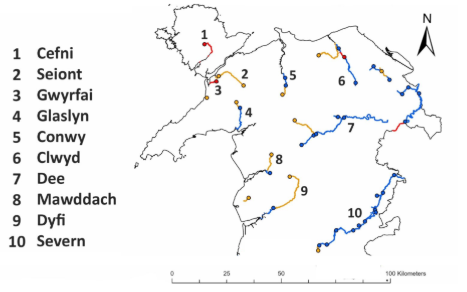
Cyfoeth Naturiol Cymru gauging station readings on major North Wales rivers as of 17th August 2026. Those in red are the rivers downstream of a gauging station at or below the lowest recorded level for that station. Those in orange are within 3cm of the lowest recorded level. Those shown in blue are more than 3cm higher than their lowest recorded level (although could still be below “normal” flows).
During the drought, some of the rivers were able to be supported by reservoirs where additional water was released by Dŵr Cymru and Hafren Dyfrdwy at the request of CNC.
As the River Dee is an important water supply, constant management is required to preserve its flow. The Dee Regulation Scheme allows the river to be closely and accurately monitored, using a combination of telemetry systems, river flow measurements, and rain gauges allowing decisions to be made to ensure a constant water level is maintained. This means that during periods of drought, such as July and August this year, more water can be released from the four reservoirs which supply the Dee, Llyn Celyn, Llyn Tegid, Llyn Brenig, and Llyn Alwen.
While this system does reduce the risk of drought or flooding, it also can unintentionally creates a hostile environment for wildlife. This is due to the introduction of barriers to fish migration, in the form of sluices and weirs, and the creation of unnatural fluctuations in water levels which can damage habitats and interrupt cues for fish migration. To remedy this, The Dee Trust have created the Environmental Flows programme which lays out a strategy for ensuring that ‘Releases from the Dee’s Reservoirs are done in an environmentally suitable way as possible’.
Similarly the River Severn has also managed to maintain a level within or just below its normal range by relying on water from Llyn Clywedog and Llyn Efyrnwy. However, the prolonged reliance on these reservoirs means that Llyn Clywedog has dropped to below 50% of its capacity. This has prompted CNC, among other environmental authorities, to apply for a Drought Order on the River Severn. If granted, this would cap the maximum daily release of Llyn Clywedog, lowering the level of the Severn further. This will increase environmental stress, but allow the river to continue to flow for longer without drying out entirely.
The recent rain has raised the water level and provided some relief to rivers in North Wales which had fallen to concerningly low levels. The Gwyrfai, Dyfi, Dysynni, and Seiont, an important river for salmon populations, have all risen to at least the low end of their ‘typical levels’.
Unfortunately the rain has not had the same impact on all rivers. On Anglesey, a part of Wales of particular concern, Afon Rhyd Y Valley still sits below the previously lowest recorded level and the river Frogwy remains within 3cm the lowest recorded level. The most recent forecast, as of the 1st of September, predicts a longer period of rainfall in the North-West, which should hopefully return these rivers to their normal level.
Looking further ahead, hotter summers and more prolonged dry periods will become an increasing pressure on our environment. The extreme drop in water level at Llyn Clywedog and near drying out of certain rivers and their tributaries is a sign of things to come and that our landscape and infrastructure are not prepared for the increased drought pressure we will experience. In preparation for future drought events existing infrastructure must be updated to ensure that no water is lost unnecessarily. A report from earlier this year also suggests stricter abstraction laws, new regulations to require homes and businesses to use water more efficiently, as well as enabling local supply options such as small reservoirs on farms.
There are also measures that could be taken higher up the catchment to increase water availability during droughts. This can be done by implementing natural flood management (NFM) practices, such as planting trees in riparian zones or along contour lines, reducing soil compaction and restoring peat bogs, or creating leaky dams. These interventions serve to ‘slow the flow’ of water, which not only mitigates flooding, but also slowly releases water stored during wet periods over a longer period of time, keeping rivers flowing for longer during droughts.
Wales needs to modernise its water infrastructure and create healthier and more resilient landscapes, as we will likely see more of the kind of conditions experienced this July and August.
Sources:
Afonydd Cymru. (2026). Lowest Recorded Levels Registered In Rivers Across Wales. https://afonyddcymru.org/lowest-recorded-levels/
Cyfoeth Naturiol Cymru/Natural Resources Wales. (2026). River levels, rainfall and sea data. https://rivers-and-seas.naturalresources.wales/?layers=river&extent=224834.13513513515+349743.2297297297+264563.86486486485+368283.7702702703+27700
Dee Trust. (n.d.). Environmental Flows. Retrieved September 1, 2026, from https://www.deetrust.co.uk/environmental-flows/
Met Office. (2026). Historic July sees record dryness, unprecedented sunshine and exceptional warmth. https://www.metoffice.gov.uk/about-us/news-and-media/media-centre/weather-and-climate-news/2026/historic-july-sees-record-dryness-unprecedented-sunshine-and-exceptional-warmth
UK Parliament. (2026). Lords Committee publish report on surviving drought, reclaiming the rain - Committee. https://committees.parliament.uk/committee/515/environment-and-climate-change-committee/news/213609/lords-committee-publish-report-on-surviving-drought-reclaiming-the-rain/